Casström proudly designs outdoor knives and equipment in Sweden with a unique style of solid craftsmanship and attention to detail. With this focus, Casström quickly became one of the leading knife brands in Scandinavia for bushcraft and survival.
“At Casström, the SFK No10 is the first knife we designed and created, and it holds a special place in our hearts. It is even more rewarding to know that those who own and use it feel just as attached to it! From the elegantly and ergonomically designed handle made from Karelian birch to the sturdy and flexible blade, this is a knife that can skin a moose or split wood equally well. At Casström, we pride ourselves on attention to detail. Our knives are of custom quality but at production cost.”

Our designs are rooted in the Swedish tradition of knife making, combined with contemporary advancements in materials and techniques. Our mission is continuous development, ensuring we produce well-crafted, quality, and high-performance tools that users enjoy. The knives are entirely made in Europe and come with a 25-year warranty. Their use is specifically targeted towards bushcraft and survival, drawing from the insights, experience, and knowledge of renowned experts like Lars Fält and Roger Harrington.*
The company is based in the small trading town of Lycksele, deep in the Swedish Lapland taiga. Located by the Ume river, Lycksele is centrally located in the wilderness of Northern Scandinavia and has been a place where people have met and done business for hundreds of years. There is a small showroom in Lycksele and an online store, but most sales are conducted mainly through a network of retailers around the world. Contact us for information on where to find dealers near you.
Our goal has always been to produce knives that last for a very long time, but we also want to improve sustainability. Our vision is to produce knives of the highest quality with the least possible impact on the environment. By using energy-efficient manufacturing methods, combined with natural and sustainable raw materials, we believe this is possible. Today, Casström chooses to use recycled steel where possible, wood from sustainable forests, and European vegetable-tanned leather. Our facilities are heated with geothermal energy and our electricity comes from carbon-neutral sources. We take responsibility for our environmental footprint and continue to develop our business this way, striving to become even more sustainable.
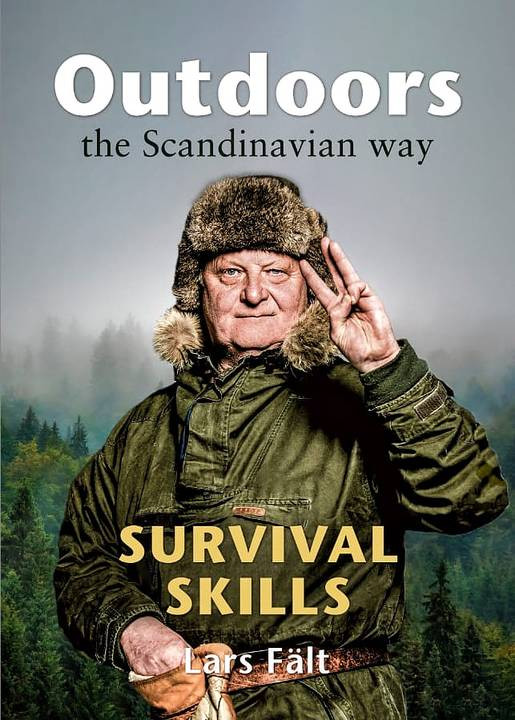
*Lars Fält is a living legend among Swedish survival and bushcraft enthusiasts. He has published numerous books on the necessary skills for living and surviving in the wilderness. Lars Fält founded the Swedish Armed Forces Survival School and led it for many years. He has extensive experience as an instructor for the Swedish paratroopers and is a trained survival instructor in the British SAS and US special forces. He has also participated in extreme expeditions from Arctic Canada to desert areas in Australia.
*Roger Harrington is an experienced adventurer and master knifemaker who has taught bushcraft and survival to civilians and the military over the past twenty years through his company Bison Bushcraft in Sussex, England.
Types of Steel and Hardening
All Casström knives are hardened at cryogenic temperatures. Cryogenic hardening is a treatment process where the steel is cooled to very low temperatures using nitrogen gas. This enhances the steel's performance at a molecular level, giving the blade greater wear resistance and making it less prone to breakage compared to a blade of the same hardness that isn't cryogenically treated.
About Sleipner Steel:
Sleipner steel allows the knife to maintain an excellent edge for a long time and doesn't damage as much under heavy use as is often seen with stainless and high alloy steels. The chemical composition allows it to be tempered to high hardness while retaining flexibility (the ability to deform without breaking) and durability, while being relatively easy to sharpen and capable of obtaining a very sharp and durable edge. Due to its 8% chromium content, it will resist corrosion to some extent compared to standard carbon steel (about 0.5% Cr), but not as well as stainless steel (13% Cr). Therefore, the blade should be dried after use and protected with oil or wax when stored in high humidity environments. Sleipner steel belongs to the category of 8% chromium steel and was developed to have durability close to simple tool steels like A2 but with much higher wear resistance, closer to D2. Casström adds a cycle of cryogenic treatment at sub-zero temperatures using liquid nitrogen after cooling to make the blades harder and enhance the steel structure. Composition: C 0.9% Si 0.9% Mn 0.5% Cr 7.8% Mo 2.5% V 0.5% (~HRC 60)
More information from Uddeholm: Sleipner technical specifications
More information on the history of 8% cr tool steels: Article from Knifesteelnerds.com
About Sandvik 14C28N Knife Steel:
The optimized chemical composition provides knife steel of the highest class with a unique combination of excellent edge qualities - sharpness retention capacity, high hardness, and good corrosion resistance. Sandvik 14C28N is a very good knife steel due to its composition, purity, and capabilities. It allows for a very fine edge. However, it tends to remain softer than ideal under conventional heat treatment procedures. Casström adds a cycle of cryogenic treatment at sub-zero temperatures using liquid nitrogen after cooling to make the blades harder and improve the steel structure. The process results in a blade with higher hardness than conventionally hardened ones and maintains a better edge for longer by optimizing the potential of the Sandvik 14C28N steel. With cryogenic treatment, Sandvik 14C28N is perhaps the most balanced stainless steel available for bushcraft knives, offering great durability, high wear resistance, and corrosion resistance. Composition: C. 0.62 Si. 0.2 Mn. 0.6 P. 0.025 S. 0.01 Cr. 14.0 N. 0.11 (~HRC 60)
Steels Previously Used by Casström:
About N690 Steel:
A cobalt-enriched stainless steel from Austrian Böhler. A steel that holds an edge really well while being relatively easy to sharpen. N690 shares some properties with other cobalt enriched steels, such as ATS-55 and VG-10. Cobalt increases the blade's wear resistance thanks to its uniform crystal structure. Composition: C. 1.08%, Si. 0.40%, Mn. 0.40%, Cr. 17.3% Mo. 1.1% V. 0.1% Co. 1.50% (HRC 58-60)
About K720 Steel:
Böhler Tool Steel K720 is a very strong oil-hardened high carbon tool steel. The chemical composition allows the knife to be hardened to a high degree while maintaining flexibility and durability, but it is easy to sharpen and can obtain a razor-sharp edge. However, the low chromium content means it will darken if left wet and should therefore be wiped down after use and protected with oil or wax when stored. Composition: C. 0.9%, Si. 0.25%, Mn. 2.0%, Cr. 0.35% V. 0.1% (HRC 58-60)
Casström Warranty and Care Certificate
This knife is made of strong materials and, if properly maintained, will last a long time. We offer a 25-year warranty from the date of purchase. We will repair or replace the knife if it breaks, but it is important to strictly follow our care instructions. Read more about warranty and maintenance guidelines below.
What is covered by the warranty?
Casström provides a 25-year warranty from the date of purchase against defects, under proper use (use as a knife) and if you follow the maintenance guidelines. Additionally, the knife should only be used for tasks it is expected to perform and not be abused. This warranty does not apply to damages caused by throwing the knife, curiosity, accidents, inappropriate use (as a screwdriver, hammer, pry bar, etc.), improper care and maintenance, neglect, or normal wear and tear.
Special Note on Wood Splitting or "Batoning" .
Batoning is a technique of slicing or splitting wood where a stick is used to deliver repeated strikes to the spine of a sturdy knife, chisel, or blade, driving it through the wood similar to the use of a Froe tool. Casström knives are generally suitable for applying batoning on clean wood (without knots) with the following warnings: A blade with a Scandi grind is covered by the warranty. Chipping or damage to the edges, damage to the tip (the last 5 mm), and handle damage from striking with wood are NOT covered by the Warranty. Casström knives with a Full Flat grind are NOT covered by the warranty when used for batoning.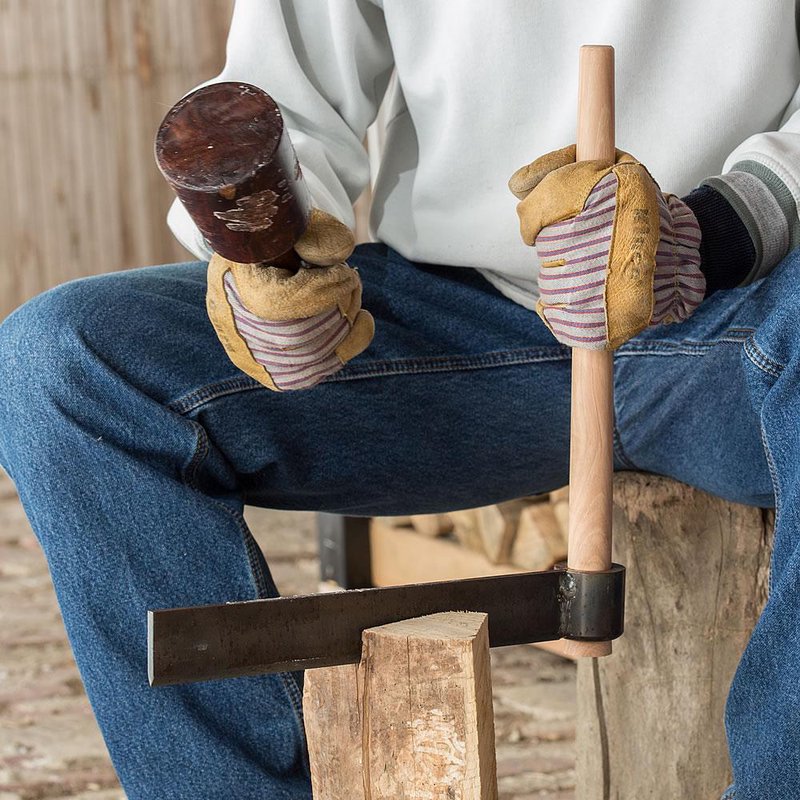
What is not covered by the warranty?
Issues such as patina/rust, natural changes in wood, some asymmetry in grinding or shaping of the handle, as well as the wood's coloration/pattern are not covered by the warranty. If you purchase a knife with any of these imperfections and you feel dissatisfied, please contact us and, in some cases, return the unused knife for a replacement.
Knife accessories such as leather sheath, firesteel, and leather straps are considered expendable over this period and are not covered by the warranty.
Care, Maintenance Tips, and Other Considerations:
- Carbon steel blades (including Sleipner) will develop a darker color or "patina" over time due to oxidation, which is normal.
- If a carbon steel blade gets wet or is used in humid or salty areas, it will rust. This applies even if cutting fruit or foods containing acids. It is recommended to wipe the blade clean and dry after use.
- Protect the steel (including exposed tang) with olive oil, mineral oil, or wax and let the blade store separately from the leather sheath when not in use, as the leather may need to dry out.
- Never place your Casström knife, regardless of the blade or handle type, in a dishwasher.
- Resharpening is recommended using flat sharpening systems, such as diamond stones, Japanese water stones, or traditional oil stones.
- Scandi grinds are best sharpened freehand on stones (natural or composite), ceramics, or diamond systems that are flat so that the length and width of the bevel can be placed flat on the abrasive surface, ensuring a consistent sharpening angle.
- With a Scandi grind, a secondary micro bevel can be added to increase durability. A 20-25 degree angle per side is recommended (40-50 degrees total if the knife is used repeatedly for batoning or other heavy tasks, especially in sub-zero temperatures Celsius).
- We recommend the secondary bevel of a Full Flat grind to have an angle of 15-20 degrees per side (30-40 degrees total) with any system or technique that provides a consistent angle.
- Final polishing of the blade with a leather strop works well for any type of bevel.
- Some variation in wood is natural and should be expected over time. Apply oil to the handle a few times a year with boiled linseed oil or another suitable oil mixture, such as Danish oil or Ronseal Finishing Oil. In the first year, we also recommend oiling the handle more frequently, for example, once a month or after each outing. If the tang gets wet and moves, gaps may form between it and the blade; these gaps can be sealed with beeswax or epoxy putty.
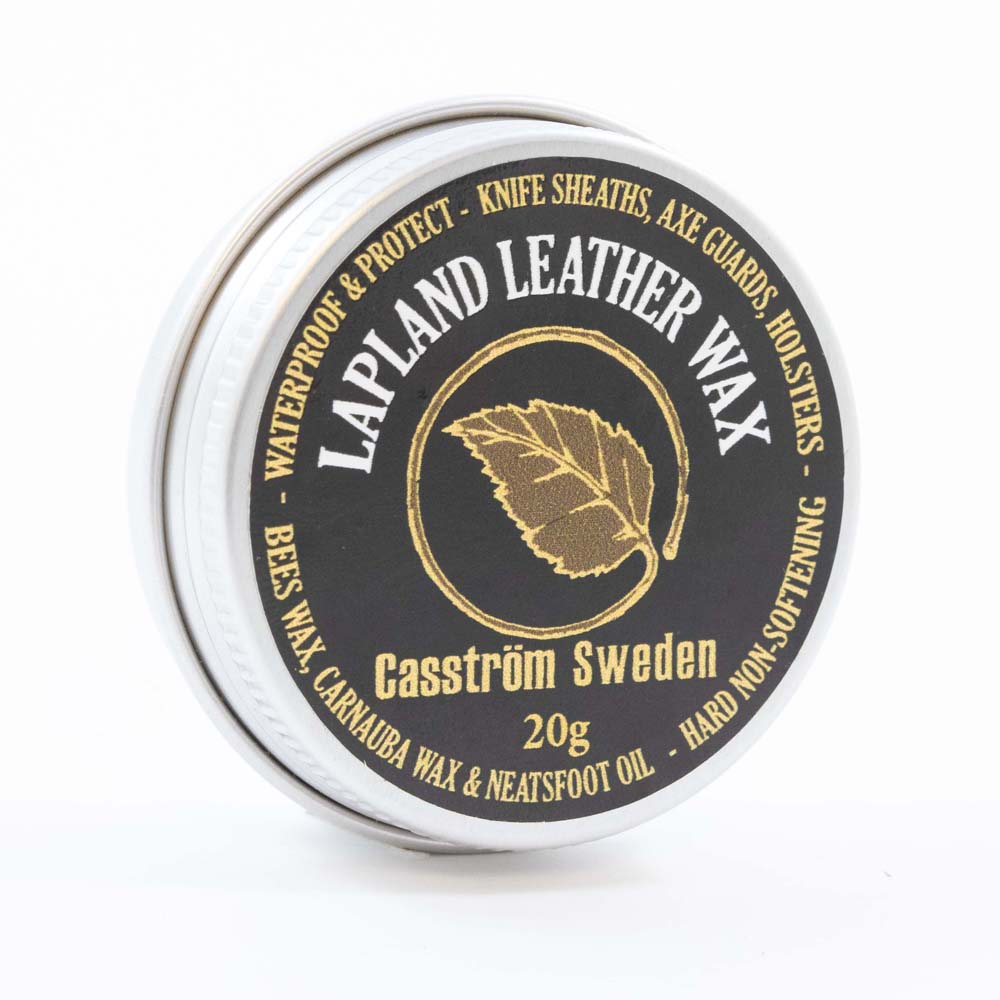
- Standard leather care products should NOT be used, especially those meant to soften and make it more supple. This ruins the sheath's ability to maintain its rigidity to protect the knife and user. We recommend Casström Lapland Leather Wax, which protects the sheath and enhances its durability.